
People Also Ask in an SEO strategy: read the questions against the results before you write
Our record of what Google's People Also Ask box returned covers 34 keywords, re-pulled on 9 September 2026. Thirty-one of the 34 returned a box at all, and those 31 boxes held 121 questions between them. In 8 of the 31, most of the questions were about a different subject than the keyword they appeared under. Those eight are printed in full further down, so you can disagree with us using our own evidence.
One of the eight is the keyword this article was planned against. For `people also ask seo strategy`, captured on 9 September 2026, Google returned four questions: What are the top 5 SEO strategies?, Is SEO still worth it in 2026?, What is the 80/20 rule in SEO? and What are the 3 C's of SEO? Not one of them mentions People Also Ask. Somebody searching for how to use that box in their planning would get an outline about general SEO strategy if they let the box write it.
This is a count and a check, not a verdict on the feature. We have not measured whether writing to those questions costs a page anything, and we say so again at the end where the limits belong. What we can show is that the box and the pages ranking beside it often answer different people, that this is free to verify on any keyword in about five minutes, and that none of the three pages we could read for this query mentions it.
What is the People Also Ask box actually for?
Google documents the box as a set of related questions, not as your keyword's question list. In its own search documentation, last updated 4 February 2026, the feature is called a "Related questions group" and described as "a cluster of questions that are related to what the user initially searched for (also known as 'People Also Ask')". The same page tells site owners what to do with it: "While you can't control what shows up here, it can be helpful to pay attention to the related search queries when you're thinking about topics you could write about for your site."
Read that sentence twice, because it carries the whole distinction. Google's framing is related to, and the suggested use is topics you could write about — a prompt for ideas across your site. It is not a claim that these are the questions the person typing this particular keyword wants answered, and Google says outright that you cannot control what appears there.
In the pages we read for this keyword, that framing has been quietly upgraded. "Topics you could write about" has become "the questions your reader is asking", and a suggestion has become an outline. The gap between those two readings is what the rest of this article measures.
Do those questions belong to your keyword's reader?
Eight of the 31 People Also Ask boxes in our record were mostly asking about a different subject than the keyword they appeared under, and 24 of the 31 carried at least one question like that. Both figures come from the same 34 keyword records, re-pulled on 9 September 2026, and both rest on a reading of ours that is set out below.
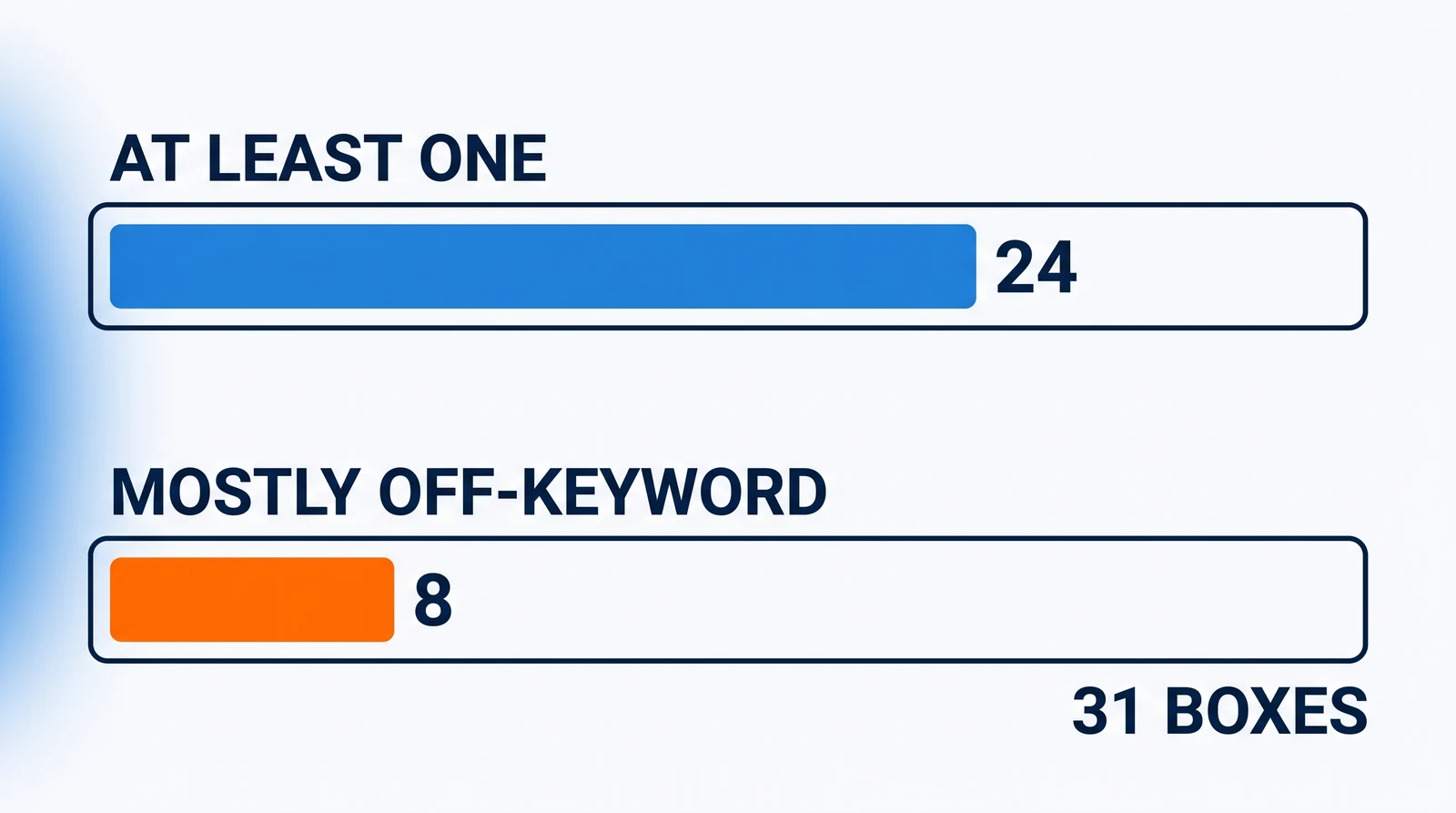
Here is where those records come from, in enough detail to repeat. When this desk plans an article it builds a contract for the keyword: the pages currently ranking, their word counts, and — free, alongside them — the People Also Ask questions and the related searches Google returned on that same results page, each stamped with the date it was captured. Those questions were captured through a third-party search-results API at a fixed location, not from a signed-in browser session. That matters, because Google says the results one person sees can differ from another's "based on things like time, context, or personalized results", and names time, location, language and device type among the things that move them. We re-pulled 34 of those records from cache, which fetched no new results pages. Three of the 34 came back with no People Also Ask box at all, which is itself worth knowing: the feature is not always there.
The 31 boxes held 121 questions, of which 90 were distinct, and counting them involves no judgement at all. The three keywords with no box are named in our own record rather than dropped.
We then read all 121 questions against the keywords they appeared under, and that reading is ours. Of each question we asked one thing: would the person who typed this keyword plausibly be asking this? If the question was about a different subject — a different field, a different task, or the opposite intent — we marked it off-keyword. If it was borderline, we marked it on-keyword, so every doubt counted against the finding we are reporting. That rule is ours, not a label the machine returned, and a careful reader can apply a stricter or looser one to the same questions below and get a different number.
The eight boxes we read as mostly off-keyword, printed whole:
| The keyword we captured against | Captured | The questions Google returned, verbatim | |---|---|---| | `people also ask seo strategy` | 2026-09-09 | What are the top 5 SEO strategies? · Is SEO still worth it in 2026? · What is the 80/20 rule in SEO? · What are the 3 C's of SEO? | | `people also ask seo` | 2026-09-09 | Is SEO still worth it in 2026? · How do I turn off people also ask in Google? · What is the most searched word on Google? · What is the "People Also Ask" feature on Google? | | `how to answer people also ask questions` | 2026-09-09 | What is the 3 question rule? · What is the psychology of answering a question with a question? · What is the "People Also Ask" feature on Google? · What is it called when people answer your question with a question? | | `how to get cited by chatgpt in 2026` | 2026-09-09 | Can you cite ChatGPT? · Which AI is best for citations? · Is 200 citations good? · How do I cite ChatGPT in MLA format? | | `what does chatgpt cite in 2026` | 2026-09-03 | How are people really using AI in 2026? · Will 90% of content be AI generated? · Is ChatGPT still the best AI? · What is the hottest topic in AI? | | `best ai visibility tool` | 2026-09-03 | How to get AI visibility? · What are the top 5 AI tools right now? · Which AI tools are best for privacy? · What is the best AI detection tool out there? | | `best ai visibility platforms with seo capabilities` | 2026-09-01 | Which AI is best for SEO content? · Which AI agent is best for SEO? · Can AI do SEO optimization? · What is AI visibility in SEO? | | `generative engine optimization companies` | 2026-08-26 | Who are the biggest SEO companies? · Which company is best for SEO? · Is generative engine optimization a thing? · Is there a SEO agency in the US? |
We build a tool that reads ranking pages for a living, so read that table as our view of those questions rather than as a neutral standard. The questions themselves are Google's own words, and the procedure that captured them is repeatable on any keyword; what nobody can re-run is this results page on this date. The column heading calling them off-keyword is ours.
Two rows show the failure most clearly. For `how to answer people also ask questions`, three of the four returned questions are about conversation rather than search: the box read "answering questions" as something people do to each other. For `how to get cited by chatgpt in 2026`, all four questions are about citing ChatGPT in your own writing, which is close to the opposite of what somebody optimising a page for citation wants to know. A writer who took either box as an outline would be answering somebody who did not type that keyword.
Why does the same question keep appearing?
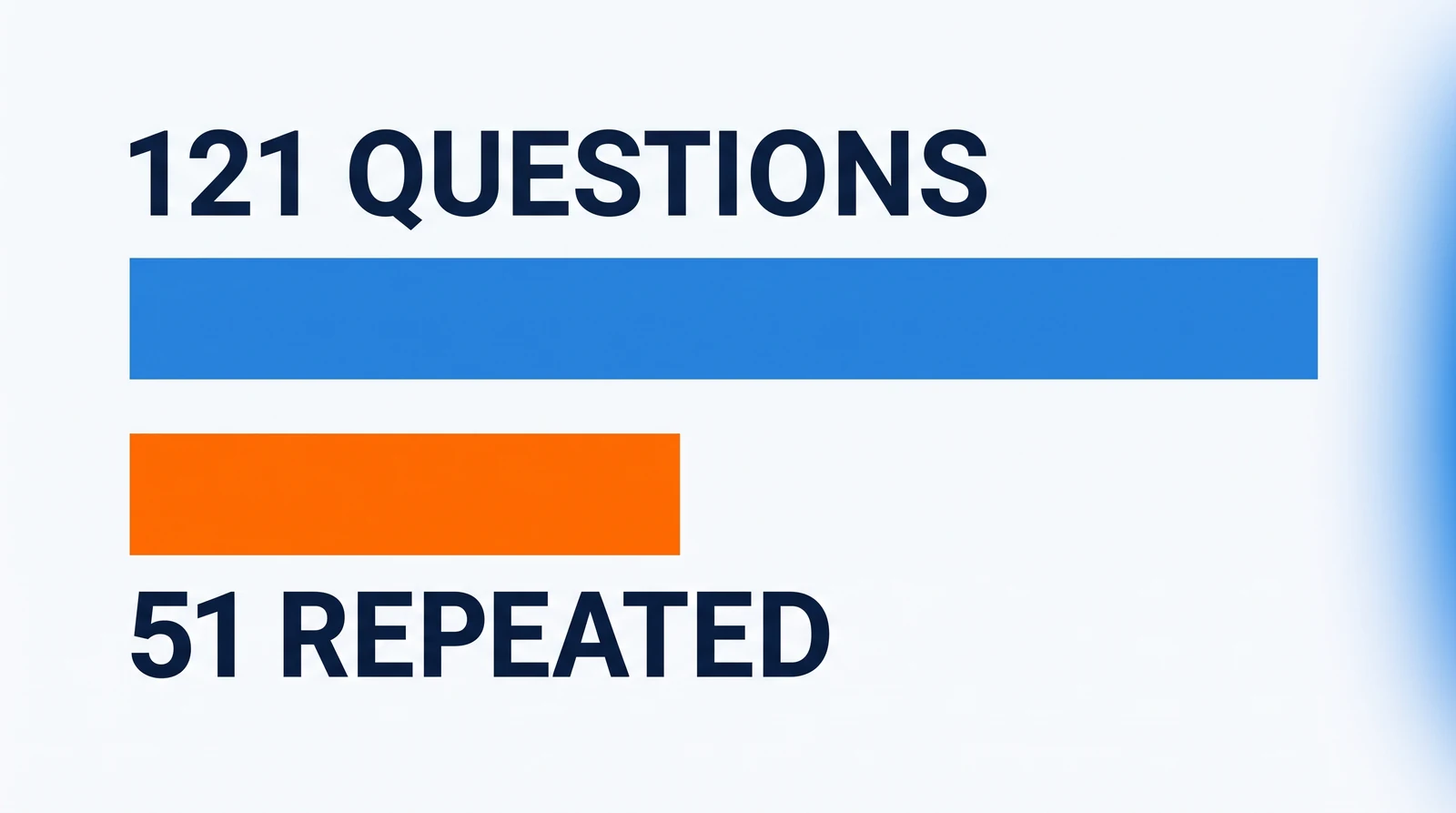
People Also Ask boxes repeat themselves across different keywords, and our record is 34 keywords in one commercial category: 51 of the 121 questions in that record were also returned for a different keyword. Twenty distinct questions turned up in more than one box. "Is SEO dead now with AI?" appeared in 6 of the 31 boxes, sitting under keywords about visibility platforms, content tools and optimisation services alike. "Which AI platform is the best for search optimization?" appeared in 5 of 31, and a question about a "30% rule" for AI in another 5 of 31, across two spellings of it.
The related searches sitting under the same results pages behave the same way, and the figures that follow come from the same 31 keywords. Those lists held 248 related searches, of which 184 were distinct. Fifty-one of the 248 were the keyword itself with a word bolted on the end — the same phrase plus free, reddit, list or examples. Sixty of the 248 contained the word "free", and 20 of the 31 lists carried the keyword followed by the single word "free". The most repeated related search in the whole set, "Free AI tools for SEO optimization", appeared beside 10 of the 31 keywords.
We read that as template rather than demand. A question that appears under six different keywords is a weak signal of what any one of those keywords' readers wants, and that is what the repetition shows. Why Google repeats it — a template, a shared topic cluster, or genuine demand the box is right about — is something we have not tested and do not claim to know. Building six articles around it produces six pages answering the same question, which is the position nobody wants to be in. The same failure shows up one surface over: in an AI visibility report, the list of prompts you choose to track decides the number you get back.
What do the pages ranking for this question tell you to do?
Answering the questions is what all three readable ranking pages advise, and not one of them advises checking whose questions they are first.
The most substantial of them, seoClarity's piece on the SEO impact of People Also Ask, published 26 February 2025 by Rebecca Brosnan, reports its own growth numbers: "Prevalence has spiked 34.7% on mobile (from Feb 2024 to Jan 2025) and 37.5% increase on desktop", and "The UK saw a 112% increase in mobile PAA prevalence from Feb 2024 to Jan 2025, with visibility peaking in November." The page names where the numbers come from — "our extensive database in Research Grid", and a "32+ billion keyword data set" it says can be filtered to queries showing a PAA. What it does not carry, for any of the three figures, is how many keywords were examined, in what vertical, or how prevalence was computed. A reader cannot check a percentage whose denominator is not on the page, and three growth figures without one are three claims you have to take on trust.
That is a criticism of an unreported method and not of the company. It is a careful, specific piece of work, more detailed than most writing on this subject, and it is reporting something its authors can see and most people cannot.
SEOptimer's guide, dated 23 August 2024, gives the standard advice under the heading "Answer the Questions Directly and Concisely", and describes the box as a research surface: "By analyzing these questions, you can identify gaps in your content strategy and discover new topics to write about." It carries one external statistic, attributed to Semrush, that "74% of the sites that appear in the PAA box aren't present on the first page of Google" — we did not verify that figure at its source, and we are reporting that the page cites it, not that it is true. It reports no measurement of its own, and it does not tell the reader to check the questions against the results.
SEO Optimizers' guide, published 20 February 2020 and last updated 20 August 2026, cites third-party figures from Sparktoro, Advanced Web Ranking and Databox, and we found no original measurement in it. Its advice on winning a place in the box is to study whoever already holds one: "Consider how sites have won coveted PAA spots. Look at your competitors' formatting, keywords and topics covered, for example." That advice assumes the box is asking the right question. If it is not, copying the pages already in it copies the mismatch.
There are eight results on this query's results page, and we could read three of them. The largest of the eight by the word count in our own capture returned an HTTP 403 to us on 9 September 2026 and we never saw a word of it, so we make no claim about what it does or does not contain. Our statement is about the three pages we opened, out of eight.
How do you check it yourself in five minutes?
A five-minute check settles it, and it needs no tool, no subscription and no data of ours: read the People Also Ask box against the pages that actually rank, in that order. The five steps below are our procedure rather than a standard, and they are shaped by what we look at all day.
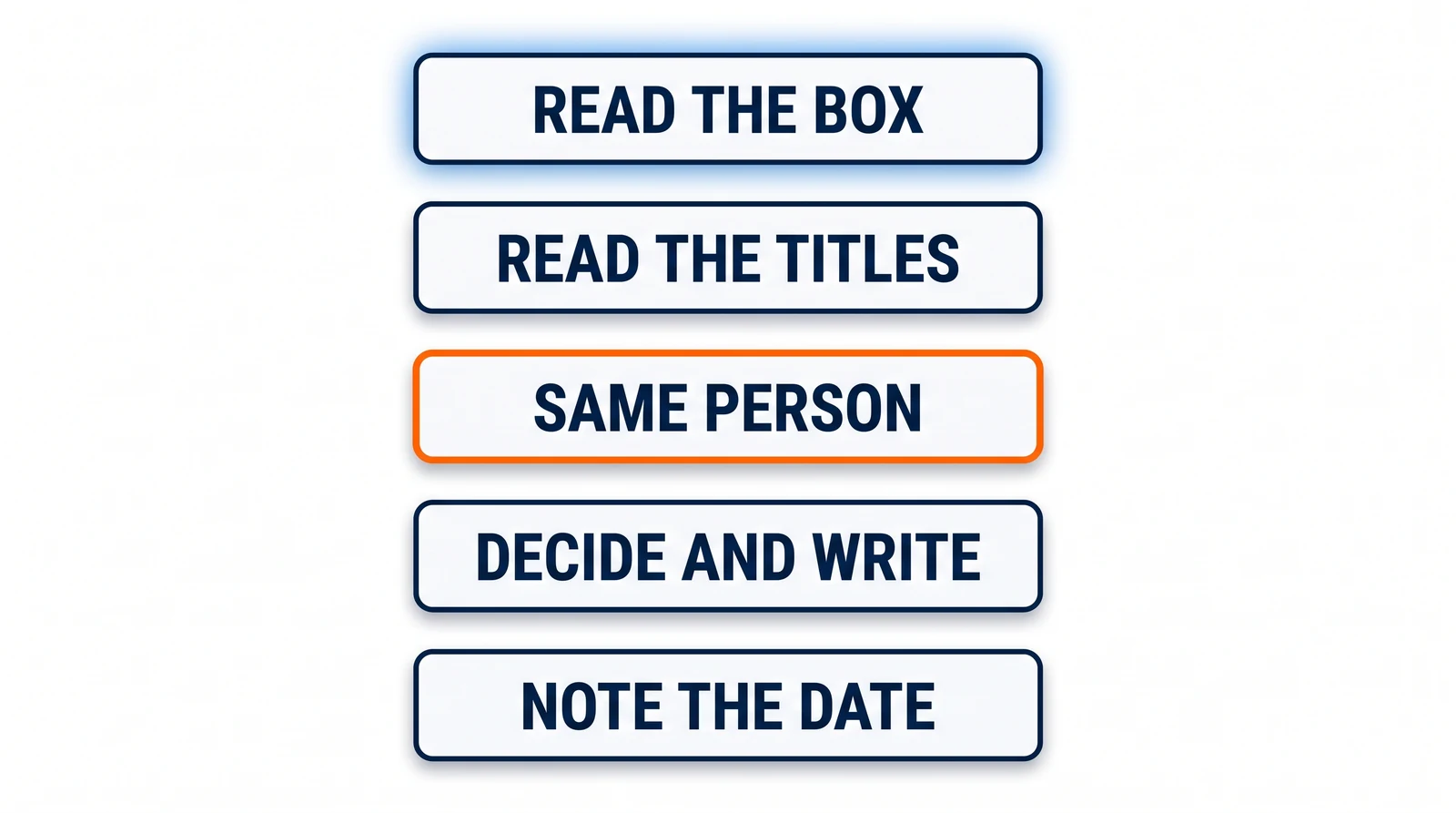
- Search your keyword and read the People Also Ask questions as they appear, without expanding them.
- Read the titles of the pages actually ranking on the same page — the first five are enough.
- Ask one question: are these two things answering the same person? A results page full of practitioner guides under a box full of definitions is a mismatch. So is a box about a different field entirely.
- If they disagree, decide which one you are writing for and write that down in your outline before you write anything else. Both are legitimate choices; the mistake is making it by accident.
- Note the date you looked. The box moves, and a capture is a photograph of one moment.
The three questions we published for checking any claim about AI search are what was measured and on how many of what, what came back null, and whether the result is about the surface you care about. This step points those same three questions at your own results page instead of at somebody's article, and the longer version is in our write-up of generative engine optimization strategies.
Tools that pull People Also Ask questions in bulk exist, and choosing one is outside what this article covers. If you want to know what a content tool does with the results page once you have it, we have written up what it extracts and where that goes wrong.
And the questions in this keyword's own box are worth handing back rather than answering here. Is SEO still worth it in 2026? and its neighbours are real questions with real answers, and they belong to our piece on what carried over from SEO and what we measured, not to a piece about reading a question box.
What this does not tell you
Consequences are the part we have not measured. Whether writing to off-keyword People Also Ask questions costs a page rankings, traffic or citations is untested by us, and anybody telling you it does is telling you something we cannot show. The honest form of our finding is narrow: for these keywords, on these dates, those were not that keyword's questions.
The record is small and early: 34 SERP contracts in one workspace and one commercial category, AI search visibility and SEO tooling, every capture taken at the location `United States`, one capture per results page, on five dates between 26 August and 9 September 2026. That 34 is what we can name from our own change log, out of 38 it says we have built — the platform has no call that lists them, so the denominator is what we could name rather than everything that exists. A reader in another market should expect a different box and should check their own.
The classification is ours and it is the softest part of the work. We marked borderline questions as on-keyword, which pushes our own number down rather than up, and we printed the eight boxes in full precisely because somebody reading them may reasonably disagree with two or three of our calls. If you do, the finding gets smaller and it does not disappear: the mechanical half — 51 repeated questions out of 121, one question in 6 of 31 boxes — involves no judgement at all.
Two limits belong to us rather than to the data. Our own scoring instrument has a published failure: tested against blind quality judgements, the drafts it rated highest were the ones the judgements rated lowest, at rho −0.61 across nine articles, and the judges there were reviewer agents rather than people. That write-up is in our piece on content optimization tools. A related result we published earlier this month is worth one sentence and no more: across our 33-keyword harvest, cited pages answered 58.8% of searcher questions and ignored pages answered 58.2%, a difference of nothing, written up in our piece on generative engine optimization features. That was a question about citations; this article is about intent.
We keep building these records every week. The set grows, we will re-count it, and when the answer changes we will publish the change.
What people actually ask us
Four questions about reading a People Also Ask box reach us more often than any others, and each answer below stands on its own.
Should I ignore the People Also Ask box? No. Read it, and then decide whose questions they are before you build anything on them. In 24 of the 31 boxes we captured, at least one question was about a different subject than the keyword, which makes the box a source of ideas that needs checking rather than an outline that can be trusted whole.
Does answering those questions get my page into the box? We have not measured that, and this article does not claim it either way. Google's own documentation says you cannot control what appears there, which is a reason to treat any confident claim about getting into the box with the same question you would ask of us: what was measured, and on how many of what?
Is this just the "search intent" advice everybody already gives? It is the checkable version of it. The usual advice is to match your content to search intent; this is a five-minute way to notice that two signals on the same results page are pointing at different intents, using nothing but the page in front of you.
Where does your data come from, and can I check it? It comes from the SERP contracts this desk builds when it plans an article, each one recording the ranking set and the questions Google returned beside it, with a capture date. The frame is stated above in full. The one thing we owe you is the receipt: our research page, last updated 12 August 2026, carries our other samples and limits but does not yet carry this count, and it should. Until it does, the numbers in this article are the record, and the eight boxes are printed here so you can check the reading yourself.
Sources
- Google Search Central — Visual Elements Gallery — the "Related questions group" definition and the statement that site owners cannot control what appears in it. Last updated 4 February 2026; verified 9 September 2026.
- Google Search Help — Why your Google Search results differ from others — Google's own account of why a results page differs between people, and the factors it names. Verified 10 September 2026.
- seoClarity — The SEO impact of People Also Ask — the 34.7% mobile, 37.5% desktop and 112% UK prevalence figures, and the Research Grid data source quoted above. Published 26 February 2025 by Rebecca Brosnan; verified 9 September 2026.
- SEOptimer — Google People Also Ask — the "Answer the Questions Directly and Concisely" advice, the content-gap sentence, and the Semrush statistic it cites. Dated 23 August 2024; verified 9 September 2026.
- SEO Optimizers — How to take advantage of Google's People Also Ask feature — the third-party figures it cites and its advice on studying competitors holding PAA spots. Published 20 February 2020, last updated 20 August 2026; verified 9 September 2026.
- LiamVi — Research: our methods, samples and limits — the harvest behind our other published results, with its samples. Last updated 12 August 2026; verified 9 September 2026. It does not yet carry the capture count reported in this article.
- LiamVi — Content optimization tools in 2026 — what a content tool extracts from the ranking set, and our own instrument's published failure at rho −0.61. Verified 9 September 2026.
- LiamVi — Generative engine optimization strategies for AI visibility — the three questions for checking any claim about AI search. Verified 9 September 2026.
- LiamVi — Best AI visibility analytics for search optimization — why the prompt list you track decides the number a visibility report returns. Verified 9 September 2026.
- LiamVi — AI tools with the best generative engine optimization features — the 33-keyword question-coverage null, with its sample. Verified 10 September 2026.
- LiamVi — AI and search engine optimization in 2026 — what carried over from SEO, and whether SEO is still worth it. Publishes 12 September 2026.
- LiamVi — How to get cited by ChatGPT in 2026 — the signals a ranking playbook sells and which of them anyone has measured. Publishes 14 September 2026.