AI-generated content and SEO in 2026: what I can tell you, and the feature we will not build
Whether a machine or a person typed your draft is not the question that decides whether an AI assistant quotes the page. I think it is barely in the top five, and I have watched an entire year of advice get written as though it were the only question there is.
I should tell you where I am standing before I say anything else. I run LiamVi. We build a content optimisation tool — you paste a draft in, it scores it against what we have measured about pages that get cited, and it tells you what is missing. It does not write the draft. That is a decision, not a gap in the roadmap, and by the end of this I want you to be able to argue with me about it.
Here is the limit, and it goes here rather than at the bottom where limits usually hide. We have not measured whether AI-written pages get cited at a different rate from human-written ones. No sample, no denominator, no controlled comparison. The nearest thing I found is a large third-party sweep of Google's AI Overviews, resting on the publisher's own AI detector and measuring something adjacent. I read it, and I come back to it below, because what it can and cannot support is more useful than its headline. So if you came here for a figure that settles the authorship question, I do not have one, and anybody handing you one this year should be asked for their sample before you believe it.
What I do have is Google's documentation, which is clearer than most of the writing about it; a handful of things my company measured about a different question and published, including the ones that made us look bad; and a decision we took about our own product that I have never written down in public until now.
Is AI-generated content fine for SEO in 2026?
Google has said in writing since February 2023 that its focus is on the quality of content rather than on how that content was produced. The Search Central post from Danny Sullivan and Chris Nelson, dated 8 February 2023, puts it exactly this way: "Our focus on the quality of content, rather than how content is produced, is a useful guide that has helped us deliver reliable, high quality results to users for years."
The line people quote from that post is the other one, and they usually quote half of it. Google writes that "using automation—including AI—to generate content with the primary purpose of manipulating ranking in search results is a violation of our spam policies." The half that gets left off the slide is the next paragraph: "it's important to recognize that not all use of automation, including AI generation, is spam. Automation has long been used to generate helpful content, such as sports scores, weather forecasts, and transcripts."
That post is three years old, so on its own I would not lean on it. The policy it points at is not old. Google's spam policies page was last updated on 28 August 2026 — a week before I read it — and the section that governs this question is called scaled content abuse. Its definition is worth reading slowly:
> "Scaled content abuse is when many pages are generated for the primary purpose of manipulating search rankings and not helping users. This abusive practice is typically focused on creating large amounts of unoriginal content that provides little to no value to users, no matter how it's created."
"No matter how it's created." Four words, in a policy document updated on 28 August 2026, and they are the whole answer to the question in this article's title.
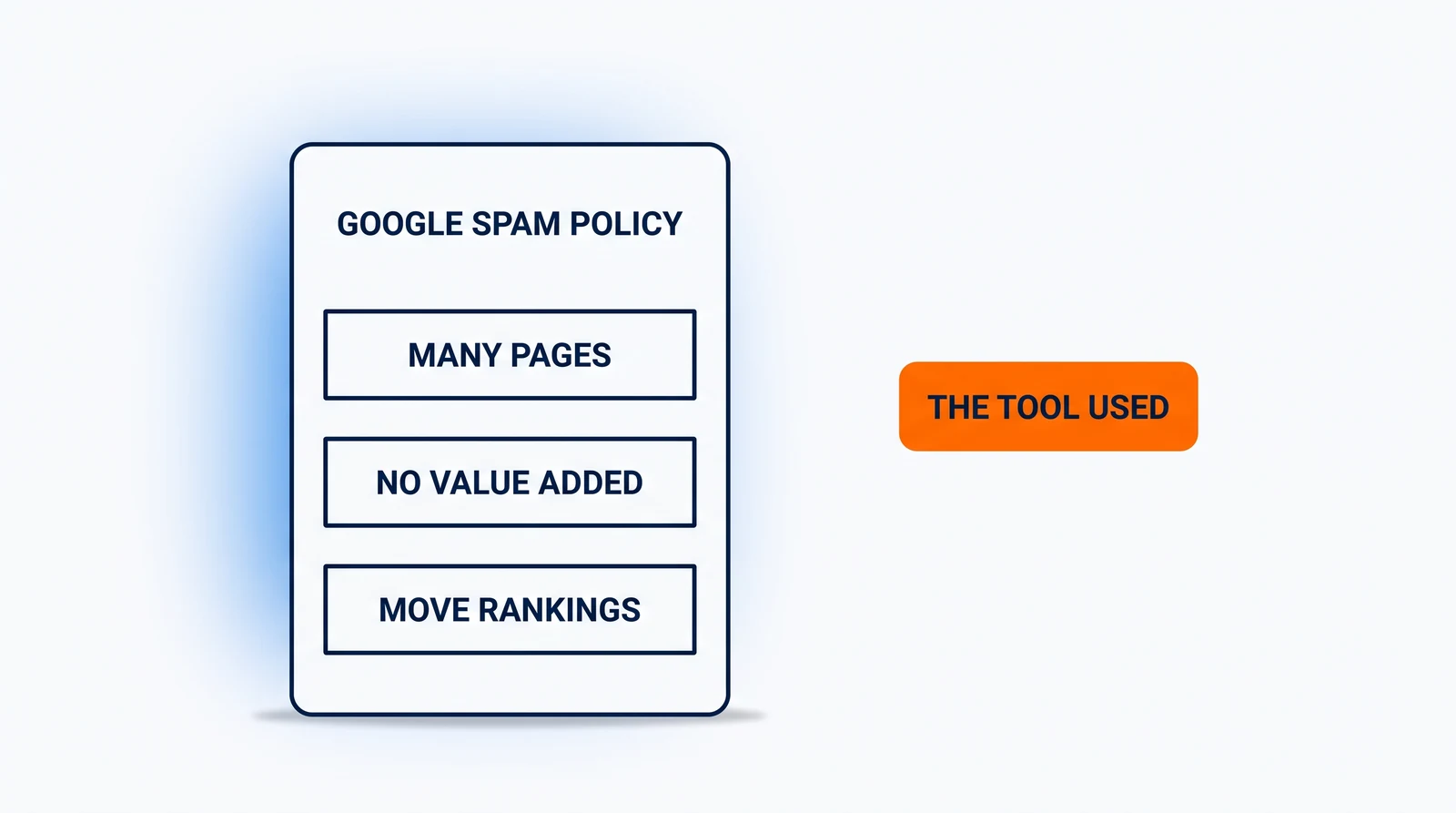
The examples listed under that policy make the same point from the other direction. Google introduces them with "examples of scaled content abuse include, but aren't limited to" and then gives five: generative AI tools used to make many pages without adding value; scraping feeds, search results or other content to generate many pages; stitching or combining content from different web pages without adding anything; creating multiple sites to hide the scaled nature of the content; and creating many pages that make little sense to a reader but carry the search keywords. Only one of the five involves AI at all, and the other four describe practices that need no language model whatsoever. What the policy describes is a shape of behaviour — many pages, no value added, produced to move rankings — and the tool you used to get there is not part of the definition.
Google's own FAQ on that 2023 page answers the two questions this results page is full of, about as plainly as a company can:
> "Appropriate use of AI or automation is not against our guidelines. This means that it is not used to generate content primarily to manipulate search rankings, which is against our spam policies."
> "Using AI doesn't give content any special gains. It's just content. If it is useful, helpful, original, and satisfies aspects of E-E-A-T, it might do well in Search. If it doesn't, it might not."
And, on whether you should use it at all: "If you see AI as an essential way to help you produce content that is helpful and original, it might be useful to consider. If you see AI as an inexpensive, easy way to game search engine rankings, then no."
The test Google actually hands you
Google's practical test for AI-generated content is a three-question one called "Who, How, and Why", and it lives on the creating helpful content help page, last updated 10 December 2025. The 2023 post ends by pointing readers at it, and that pointer is the part most write-ups skip.
Who is about whether it is self-evident to your visitors who created the page: Google writes that "we strongly encourage adding accurate authorship information, such as bylines to content where readers might expect it."
How is the one that speaks directly to this subject. Google's help page says outright that a "How" component "can include automated, AI-generated, and AI-assisted content", and asks three questions of it: whether the use of automation is self-evident to visitors through disclosures or in other ways, whether you are giving background on how it was used, and whether you are explaining why it was seen as useful.
Why is the one Google calls "perhaps the most important question to answer about your content", and its answer is a fork: "the 'why' should be that you're creating content primarily to help people… If the 'why' is that you're primarily making content to attract search engine visits, that's not aligned with what our systems seek to reward."
Read the three together and the shape of Google's position is consistent from 2023 to the policy page updated last week: the test is about purpose and disclosure, not about the tool. That is the section. I am deliberately not going to write you a general SEO guide around it, because the other pages on this results page have already done that and several of them are good at it. Google's position is reported here; it is not mine, and I have nothing to add to it.
Can Google detect AI-generated content?
Google's published documentation describes a policy about the purpose of a page, and nowhere in it does Google describe an AI-content detector or claim to run one.
I want to be careful about how I say that, because it is an absence and absences are easy to overstate. On 4 September 2026 I read three Google pages in full — the 2023 guidance on AI-generated content, the spam policies, and the creating-helpful-content help page — and searched all three for the words detect, detector and detection. Neither of the two AI-facing pages uses any of the three anywhere in its guidance. The spam policies page uses "detect" five times and never once about text: the relevant sentence is "we detect policy-violating practices both through automated systems and, as needed, human review that can result in a manual action." Practices, not prose.
Three pages is three pages. It is not proof that no such system exists inside Google, and I am not claiming that. What I am claiming is narrower and checkable: Google has documented a great deal about how it treats AI-generated content, and in none of it does it say it identifies which words a machine wrote, or that it would treat them differently if it could. The sentence it offers in that space instead is "using AI doesn't give content any special gains. It's just content."
I think the reason this question feels so urgent is that it is the wrong shape. A detector question assumes there is a hidden penalty to be caught by. The published policy is not a hidden penalty; it is a description of a kind of page — mass-produced, unoriginal, nothing added — and if your page is that kind of page, how it was made is not what gets it into trouble.
There is also a more useful question sitting underneath the anxious one, and it has nothing to do with detection. Two different decisions now get made about the same page: where it ranks, and whether a sentence gets lifted out of it and put in an answer. Whether those are two separate systems depends on whose engine you mean. For its own surfaces, Google says they are not. Its guide to optimising for generative AI features, last updated 10 July 2026, says that "our generative AI features on Google Search are rooted in our core Search ranking and quality systems." It describes retrieval-augmented generation as working "by relying on our core Search ranking systems to retrieve relevant, up-to-date web pages from our Search index", and it states that from Google Search's own perspective "optimizing for generative AI search is optimizing for the search experience, and thus still SEO." That is Google, on Google — and it is a fourth Google page, updated this July, that uses none of those three detection words either.
What my company measured is a different engine. We compared what ChatGPT cited against what ranked on Google for the same queries, and in that harvest the two decisions came apart — an overlap nine pages wide, which I get to below. My read is that the second decision is therefore worth studying on its own terms. Let me be exact about what kind of statement that is: a read about where to look, drawn from one engine and one harvest, not a claim about how anybody's ranking systems are wired. A detector, if one existed, would only ever have been about the first decision. Everything I have to offer of my own is about the second, and that is the rest of this article.
What is the 30% rule for AI?
The 30% rule is not something I have tested, and I have no view on whether any such threshold exists. I am answering it because the question is asked constantly around this subject and I would rather say "untested" than fill the space.
I did go looking for its source in the obvious place. In the three Google pages above, read in full on 4 September 2026, the string "30%" does not appear once, and neither does "30 percent". Google's guidance on AI-generated content, its spam policies and its helpful-content documentation contain no threshold of that kind at all. That is not proof that no such rule exists anywhere — only that it is not in the documentation people usually gesture at when they mention it.
If somebody quotes you a percentage of a page that is safe to generate, ask them two questions before you write it down. What was the sample, and what counted as a page passing? A ratio with no denominator behind it is not a finding; it is a number with a confident tone. I hold my own company to that and it costs us — it is why several sentences in this article are shorter and less satisfying than the equivalent sentences elsewhere on this results page.
The question this results page mostly answers — and the one it mostly does not
Five of the six readable pages ranking for this question answer it entirely about Google ranking. Only one of the six takes on the harder question of whether an AI answer will cite the page at all.
I opened the results for this query on 4 September 2026: nine pages, of which six could be read. Those six were Google's own post, a search-industry publication's guide, a marketing platform's blog post, an SEO company's blog post, a marketing agency's insight page, and a content-platform vendor's blog post. The three I could not read were a three-year-old forum thread and two pages that refused the request, so I am not going to characterise those. Whether Google will penalise an AI-written page is a fair question, and 2023 was the year to ask it — but it is not the only decision being made about a page in 2026.
The one page that does ask, and why its answer does not settle it
Search Engine Land's guide to AI-generated content, last updated 12 December 2025, is the one page of the six I read that asks whether AI-generated content actually gets cited. It reports a third-party study finding that a large majority of the content cited in Google's AI Overviews was at least partly AI-generated, and — to its credit — it flags the problem with its own evidence in its own words: "One small caveat here: This research relies on an AI detection system. It's unclear how accurate that is."
Their sentence links straight to the study, so I opened it. It is Ahrefs' analysis of what AI Overviews cite, published on 14 July 2025. Here is its sample in its own terms: one million search results pages showing an AI Overview, the top three cited links taken from each, 1.9 million cited URLs in total, of which 500,000 sat in Ahrefs' own index and could be checked. Every one of those went through Ahrefs' own AI content detector. Of the 500,000 cited URLs Ahrefs could check, it classified 3.6% as pure AI, 8.6% as pure human and 87.8% as a mix of the two. Ahrefs also prints the limit on its own instrument, which is more than most pages on this subject manage: "No AI content detector is perfect… They can be incredibly accurate, but they always carry the risk of false positives."
Then there is the question a share of cited content can actually answer, and it is not the same as a citation rate. To know whether AI-assisted pages get cited more or less often than pages written by people, you need something to compare against — what share of the eligible content looks AI-assisted in the first place. They went further than the headline suggests and set that comparison themselves. In a separate analysis of 900,000 new pages, Ahrefs classified 2.5% as pure AI and 25.8% as pure human. Set against that, the cited pages — 3.6% pure AI and 8.6% pure human — lean the way their title says they do. Ahrefs is careful about the comparison in its own words: "this research looked only at new pages (and not all cited URLs in AI Overviews will be new)." That caution is the right one. New pages are not the pool those AI Overviews were choosing from.
The number in it I would actually keep is the one the write-ups leave out. Across that whole dataset, the correlation between how AI-assisted a page was and where it came in the citation order was 0.017, which Ahrefs describes as effectively zero. They read it as Google neither penalising nor rewarding authorship when it picks its sources. That is their measurement rather than mine, taken on their detector's output rather than on known authorship, and a correlation across a scrape is not the matched-pages test I describe at the end of this piece. It also happens to point exactly where my first sentence pointed, which is a reason to handle it carefully rather than a reason to be pleased.
So what the nearest evidence supports is narrower than the headline. On one engine's surfaces, judged by one company's detector, AI-assisted pages were over-represented among the citations. How AI-assisted a page was had no useful relationship with how highly it was cited. What nobody has published is the comparison that would answer the authorship question, and that includes us. Our own harvest is 33 keywords and mostly one engine, and it measures which pages got cited rather than who or what wrote them. None of this is a criticism of the guide, which reported the study with its caveat attached and pointed me at the source.
So the question is still open, and here is what my company measured about the other decision. Across a 33-keyword harvest, nine of the 276 ranking pages were also cited by the engine, out of 73 cited pages in all — the overlap between what ranked and what got quoted was nine pages wide. The nine-page overlap is our own number from our own harvest, and the method, the samples and the limits are published.
I use that figure carefully, so let me say exactly what I take from it and what I do not. I do not take from it that ranking is irrelevant, or that citation is the more valuable outcome, or anything at all about who typed the words. What I take from it is narrower: in the set we looked at, ranking well and getting quoted were close to separate outcomes, which means a workflow optimised entirely for the first is not automatically doing anything for the second.
The mechanism underneath that number is the part that makes it mean something. Some of the citations we recorded came back pointing at a single highlighted sentence inside a page rather than at the page itself, and one article in our harvest was cited four times for four different passages. That is a fact about where a citation lands. It is not a measurement of how the page was chosen, and I have not measured that step. My read is that a citation arriving sentence-shaped is worth taking seriously as a hint about the unit the decision is being made in, because almost everything the industry measures — length, coverage, term density, domain authority — is a property of a whole page. If the decision is being made one sentence at a time, page-level scores are answering a question nobody asked.
There is one more piece of evidence, and I want to flag what kind of evidence it is before I use it. Asked to describe its own source selection, ChatGPT told us it often ignores pages that add no new evidence — five articles repeating one press release are not five independent sources — and that is a self-description, not a measurement. Models produce plausible-sounding accounts of themselves, and we would not publish that on its own. We published it because it matched something we had already measured blind, and because it named a fault in our own product before we did.
And the limits, which are ours and which I would rather you heard from me than found later. The harvest is 33 keywords, three related industries, and mostly one engine — ChatGPT. The overlap counts are pages rather than domains. One harvest is one moment. We cannot yet prove causation: we can say what cited pages had in common, not that adding those properties causes a citation. Our citation dataset is early: enough to have changed our own product decisions, and not enough to call a law. The distance between those two sentences is most of what I think is wrong with how this industry writes.
Why we do not generate content, and what that decision costs us
LiamVi will not write your content for you, and that is a deliberate product decision rather than a feature we have not got round to. It predates this article by a long way, and the reasoning starts with something embarrassing rather than something clever.
Start with what a content optimisation tool is actually fitted to. Two of the six products we checked in this category on 27 August 2026 describe that target themselves: one grades a draft "against top-ranking pages", and another says its content score rests on having "quantified what ranks". The early version of ours worked the same way. The shape is: read the top results, extract what they have in common, and grade the draft on how much of that consensus it has reproduced.
I have not surveyed the whole market and I am not claiming every product in it works like that — the page linked above records what each of the six says about itself, in its own words, with the date we verified it. I am not going to characterise anybody's product here; the vendors say what they do better than I would say it for them.
Now the embarrassing part, which is ours. Our own research page says this about our own scorer: "our early scorer rewarded matching the top-ten consensus, which is the set our harvest shows is nearly disjoint from what gets cited." We built a meter that pushed writers towards saying what the ranking pages already said, then measured that the ranking pages and the cited pages barely overlapped. The meter was pointing at the wrong target, and we had shipped it.
We found the same fault a second time from a completely different direction. We took a set of drafts, had them read cold for quality with none of the scores visible, and compared those judgements against what our fitted content score had said. The score ran the wrong way: the drafts our meter rated highest were the ones the cold reads rated lowest, and we published that result. I want to be exact about who did the reading, because it matters and because we have been imprecise about it before. Those cold reads were done by independent reviewer agents on a seven-dimension scorecard, not by people. A human blind read of the same set is prepared and not yet done, and we will publish it when it is, whatever it says.
What we did about it was stop selling a score as a quality grade. Ours was rebuilt as a coverage checklist — what you are missing, not how good you are — and the whole trial, including the confounds we logged rather than buried, is on the research page.
So here is the decision, and the reasoning that produced it. If the instrument we are best at building is a meter fitted to the consensus of what already ranks, then a writing feature bolted to that meter is a machine for producing the consensus at speed. Our own evidence says the consensus is not the set that gets quoted. I did not want to build the fastest available route to the wrong target and sell it as help.
And I should say what the decision costs, because otherwise this is just a nice story about principles. Two of the six products we checked describe generating drafts as part of what they sell — in their own published words, on our page, with the date we checked them. My read is that a generate button is what a lot of people shopping for one of these tools actually want, and not having one makes us a smaller product with a narrower promise, in a market where "we write it for you" is a much easier sentence to sell than "we tell you what your draft is missing". We are early — the product is in early access and you have to ask for it — and turning down the feature people want is not a comfortable position for a company our size.
It is fair to ask what we get out of publishing that, and I would rather answer it than let it sit. We get exactly one thing: you can check this claim. The measurements are on a page with their samples and their limits, the null results are on it too, and if the argument I am making here is wrong you can find that out from our own material rather than from a competitor's. I think that is the only durable advantage a company this size has, and it stops working the moment we publish something we cannot stand behind.
The strongest argument against me
The best objection to refusing to build a generation feature is that we found a fault in the target rather than in the generation — and I would rather write that argument out properly than leave it in a footnote.
The objection goes like this. Your meter aimed at the ranking consensus. The ranking consensus turned out to be nearly disjoint from what got cited. That is an argument for changing what you aim at, not for refusing to aim. Point a generator at the right target — passages worth lifting, specifics nobody else on the results page has — and you would be helping people produce faster exactly what you say gets quoted. Your refusal is a preference dressed up as a finding.
That is a good argument. I do not think it is wrong so much as unfinished, and the honest thing is to separate which half of my answer is measurement and which half is judgement.
The measured half: in our harvest the ranking consensus and the cited set barely overlapped, and we know what our own meter did when it was fitted to the first of them.
The judgement half, and it is mine rather than the desk's: what seems to get a page quoted is that it carries something no other page on the results has — a specific, a figure, a case, a decision and the reason behind it. That property is the one I cannot see how to generate, because it does not come from the results page at all. It comes from the business. If you have run a test, priced something, made a mistake, or decided something and can say why, that is the material, and no model has access to it unless you put it there. A tool that offers to supply it is offering to make it up.
So my position is not that generated text is bad. It is that the scarce ingredient is not text, and I do not want to sell a faster way to produce the abundant one. I have not measured that. If someone runs the comparison properly and it comes back against me, I will publish that too — we have published against ourselves twice already, and both times it was the most useful thing we did that month.
What I would actually do about it
The check worth running on a finished page is whether it carries at least one self-contained sentence, with a figure or a named thing in it, that no other page on that results page has. It is a question that does not care who typed the words.
If the answer is no, you have written the consensus, and that is equally true whether a model produced it in four minutes or you produced it in four hours. If the answer is yes, then how it got written is a workflow question rather than a strategy question, and you can settle it on whatever grounds you like — cost, speed, or how much you enjoy drafting.
Two things I would check before that, in order.
Before you write, check whether the question makes the assistant go and look for pages at all. This is the check that saves the most wasted work. In our pre-registered test, none of the conceptual "what is X" framings triggered source retrieval on the engine we measured, while every dated, comparison-shaped framing did — five topics, one engine primarily, and the exact rates are not portable. If an assistant answers your question from memory without going to look, no page wins that citation, however the page was produced. Choosing which question to write about is a keyword and angle decision, and it is made before a single word is drafted.
After you write, go looking for the sentence that could be lifted out. Not the paragraph — the sentence. Self-contained, specific, carrying a figure or a named entity, stating a fact in your own voice rather than passing it on to somebody else. If you cannot find two or three of those, the page is a summary of other pages, and pages assembled from the consensus of what already ranks are precisely the pages an LLM skips.
Read both checks as my view rather than as a neutral standard. We built our tooling around exactly these measurements, which is a real conflict of interest, and I would rather name it than have you find it. Both checks come from an early dataset, mostly one engine, and both are what we observed rather than a rule about the web.
On disclosure, since it comes up whenever this subject does: Google says AI or automation disclosures are "useful for content where someone might think 'How was this created?'" and to "consider adding these when it would be reasonably expected", and it says separately that giving AI an author byline is probably not the best way to make that clear. That is Google's position, reported. Whether your readers would reasonably expect a disclosure is a question about your readers, and I do not know them.
What I am still not sure about
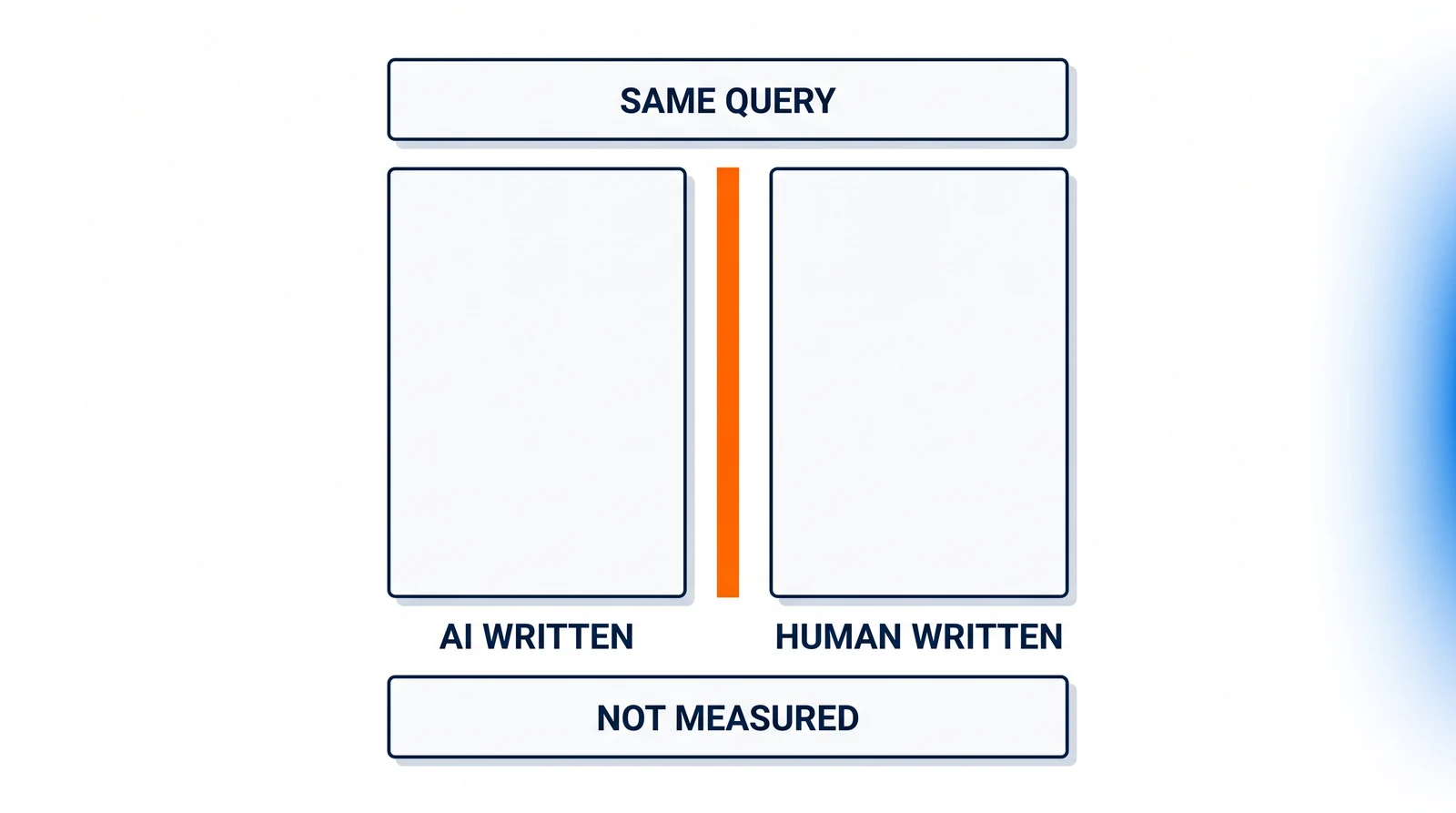
I do not know whether AI-written pages get cited less often, more often, or at exactly the same rate as pages written by people. Nobody has shown me a controlled comparison and we have not run one; the sweep above is the closest thing on the table, and it compares one detector's output across two different pools of pages rather than matched pages against each other. It is a genuinely answerable question — you would need matched pages on the same queries, written both ways, and an outcome measure that is not a proxy — and I would like to see somebody do it properly. If we get there first it will go on the research page with its sample and its limits, including if it says we have been wrong about this.
I also do not know how stable any of it is. The retrieval behaviour we measured could change without an announcement, and the policies I quoted above are documents that get edited; the dates on my sources are there so you can check whether they still say what I said they said.
That is my read. You know what your business knows that nobody else does, and I do not — so whether a model can help you get that onto the page is your decision to make, not mine to make for you. What I would not do is make it on the basis of a penalty that Google has spent three years saying, in writing, that it does not apply.
Sources
- Google Search Central — Google Search's guidance about AI-generated content, published 8 February 2023, including its FAQ. Checked 4 September 2026: https://developers.google.com/search/blog/2023/02/google-search-and-ai-content
- Search Engine Land — AI-generated content guide, last updated 12 December 2025 (the caveat quoted above, and the link that pointed me at the study). Checked 4 September 2026: https://searchengineland.com/guide/ai-generated-content
- Ahrefs — AI Overviews Cite AI-Generated Content More Than Human Writing, by Si Quan Ong with Xibeijia Guan, published 14 July 2025 (the one-million-SERP sweep, the 500,000 classified URLs, the 900,000-new-page comparison, the 0.017 correlation, and their own detector caveat). Checked 4 September 2026: https://ahrefs.com/blog/ai-overviews-cite-ai-generated-content-more-than-human-writing/
- Google Search Central — Optimizing your website for generative AI features on Google Search, last updated 10 July 2026 (generative AI features rooted in core Search ranking, and the definition of retrieval-augmented generation). Checked 4 September 2026: https://developers.google.com/search/docs/fundamentals/ai-optimization-guide
- Google Search Central — Spam policies for Google web search, last updated 28 August 2026 (the scaled content abuse policy and its examples). Checked 4 September 2026: https://developers.google.com/search/docs/essentials/spam-policies
- Google Search Central — Creating helpful, reliable, people-first content, last updated 10 December 2025 ("Who, How, and Why", and the disclosure guidance). Checked 4 September 2026: https://developers.google.com/search/docs/fundamentals/creating-helpful-content
- LiamVi — Research: our methods, our samples, last updated 12 August 2026 (the 33-keyword harvest, the passage finding, the framing ladder, the blind-read trial and its limits). Checked 4 September 2026: https://liamvi.com/research/
- LiamVi — Top user-friendly AI search optimization tools (the 276 ranking pages and the 73 cited pages). Checked 4 September 2026: https://liamvi.com/blog/top-user-friendly-ai-search-optimization-tools
- LiamVi — The best AI visibility tools in 2026, published 10 August 2026 (the page that gets skipped). Checked 4 September 2026: https://liamvi.com/blog/best-ai-visibility-tool
- LiamVi — How to get citations from ChatGPT (the engine's self-description, marked as one). Checked 4 September 2026: https://liamvi.com/blog/how-to-get-citations-from-chatgpt
- LiamVi — Content optimization tools in 2026 (six products in the vendors' own published words, verified live 27 August 2026). Checked 4 September 2026: https://liamvi.com/blog/content-optimization-tool